

Early laser systems were calibrated for light skin paired with dark hair, a combination that handed the laser an easy target. Anyone outside that range was often turned away or treated with settings that carried real risk.
The technology has changed since then. At our Rockaway Park practice, laser hair removal in Queens, NY is performed with the Lutronic Clarity II, a dual-wavelength platform that includes the exact wavelength dermatologists treat as the standard of care for the deepest skin tones.
This guide walks through why dark skin calls for a specific approach, which laser settings make the difference, and what a treatment plan designed around your skin actually looks like.
How laser hair removal actually works
Every laser hair removal device relies on a process called selective photothermolysis. The laser emits light at a wavelength that pigment absorbs well. That light energy converts into heat, and the heat damages the follicle structure responsible for producing hair. The aim is to concentrate that heat deep in the follicle while leaving the surface of the skin untouched.
The complicating factor for dark skin is melanin. Melanin is the pigment that gives both hair and skin their color, and it sits in two places that matter here. It is in the hair follicle, where you want the laser to act, and in the epidermis, the outer layer of skin, where you do not. On lighter skin, the contrast between dark hair and pale skin gives the laser a clean target with little competition. On deeper skin tones, the epidermis holds far more melanin, so a poorly matched laser can dump heat into the skin itself. That misdirected energy is what produced the blistering and uneven pigment changes that older devices were known for.
Where your skin falls on the Fitzpatrick scale
Clinicians describe skin tone using the Fitzpatrick scale, a six-point system that ranks how skin responds to sun exposure. Types I and II cover the lightest skin that burns easily. Types III and IV sit in the middle. Types V and VI describe brown through deep brown and black skin that rarely burns and tans readily. The scale matters for laser work because it predicts how much melanin sits in the epidermis, and that figure guides every setting the clinician chooses.
If your skin falls into Fitzpatrick IV, V, or VI, the wavelength of the laser is not a minor detail. It is the single factor that separates a safe, effective treatment from one that puts your skin at risk. A reputable provider will assess your Fitzpatrick type during your consultation and explain how it shapes your plan.
The wavelength that makes it safe
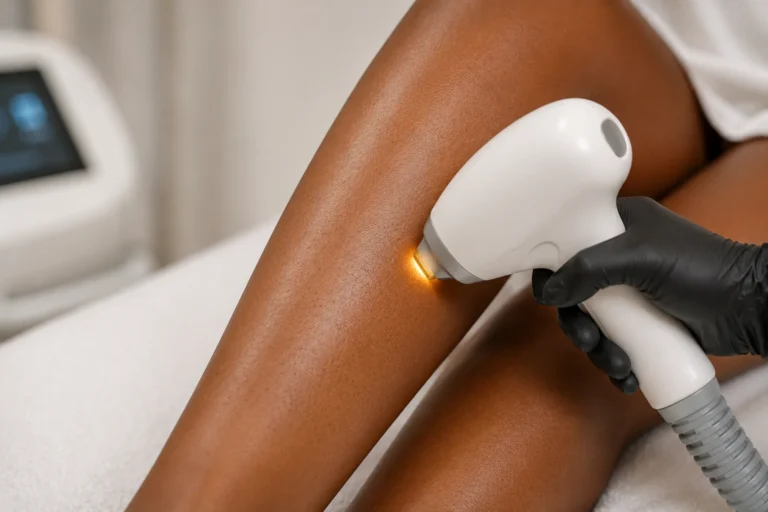
The solution for dark skin comes down to wavelength. Shorter wavelengths, such as the 755 nm alexandrite, are absorbed strongly by melanin close to the surface. That makes them efficient on light skin and genuinely risky on deep skin. Longer wavelengths travel further into the skin and are absorbed far less by surface pigment. The 1064 nm Nd:YAG wavelength sits at the long end of the range used for hair removal, and it has become the accepted choice for Fitzpatrick types IV through VI.
The Nd:YAG reaches the follicle while passing more safely through melanin-rich epidermis. It is paired with contact cooling that lowers the skin temperature immediately before and after each pulse, which protects the surface and keeps the session comfortable. The Lutronic Clarity II we use carries both the 755 nm and the 1064 nm wavelengths in one platform, so the clinician selects the setting that matches your skin instead of forcing every client onto a single fixed protocol.
| Laser wavelength | Penetration depth | Best suited for | Notes for deeper skin tones |
| 755 nm Alexandrite | Shallow | Light skin with dark hair | Heavily absorbed by surface melanin, which raises the risk of burns and pigment changes on dark skin |
| 810 nm Diode | Moderate | A broad range of skin tones | Workable for medium tones, less suited to the very deepest skin |
| 1064 nm Nd:YAG | Deep | Fitzpatrick types IV through VI | Low absorption by surface melanin, which makes it the standard choice for dark skin |
What the research shows
The clinical record behind the Nd:YAG approach is steady. In a 2025 study published in the journal Lasers in Medical Science, researchers treated 55 women with Fitzpatrick skin types IV through VI using a low-fluence 1064 nm Nd:YAG laser and recorded no adverse events and no paradoxical hair growth across the entire group. A number of participants also reported their skin tone looked more even after treatment. Results like these are why the longer wavelength has shifted from a cautious option to a default recommendation for deeper skin.
What a treatment session involves
Every plan starts with a consultation. A clinician examines your skin tone, your hair color and texture, and the area you want treated, then sets the laser parameters to match. For darker skin, a patch test is standard practice. The clinician treats a small section, waits a few days to see how your skin responds, and confirms the settings before committing to a full session. This step is one of the clearest signs you are in careful hands.
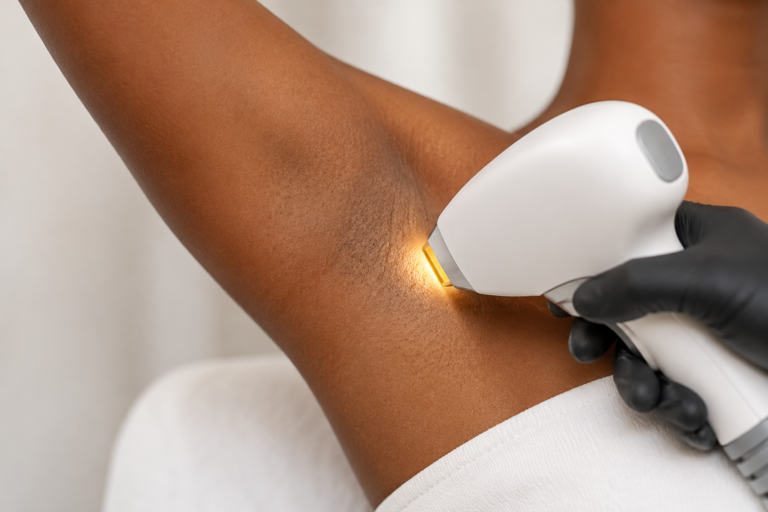
During treatment, the laser handpiece passes across the area in overlapping pulses. Most clients describe the sensation as a quick, warm snap against the skin, close to the flick of a light elastic band. Contact cooling takes the edge off the heat. A small zone such as the upper lip or chin can be finished in a few minutes, while larger areas like the legs or back take longer but still fit inside a single appointment.
Afterward, the treated skin often looks slightly flushed and feels warm, similar to mild sun exposure. That usually settles within a few hours to a day. You can return to most of your normal routine right away, with a handful of adjustments covered below.
How many sessions you will need
Hair grows in cycles, and a laser can only disable a follicle that is in its active growth phase at the moment of treatment. At any given time, a share of your hair is dormant and effectively invisible to the laser. This is the reason a course of sessions is necessary rather than a single visit.
Most clients see a meaningful, lasting reduction after six to eight sessions, spaced roughly four to eight weeks apart depending on the body area. Facial areas tend to need shorter intervals than legs or backs. Hormones can influence hair growth too, so zones like the chin and jawline sometimes call for occasional maintenance sessions once the initial course is complete.
| Planning tip: Schedule your course to begin in fall or winter. Treated skin is more sensitive to sunlight, and the shorter daylight months make it easier to keep the area covered and protected between appointments. |
Common treatment areas include the underarms, legs, bikini line, back, chest, face, and neck. The same Nd:YAG approach applies whether you are treating a small patch on the face or a full leg. For clients weighing up more intimate areas, our Brazilian laser hair removal guide covers what to expect in detail.
How to prepare for your appointment
A few habits in the weeks before your session protect your skin and improve your results:
- Shave the treatment area one to two days beforehand rather than waxing, plucking, or threading. The laser needs the follicle root in place, and shaving clears the surface hair while leaving that root intact.
- Stay out of direct sun and skip self-tanner for about two weeks before your appointment. A tan, whether from the sun or a bottle, raises the melanin level in your skin and changes how the laser reads it.
Aftercare and protecting your results
Aftercare for deeper skin centers on keeping the treated area calm and shielded. Keep the skin cool and well moisturized, avoid hot showers and saunas for the first day or two, and skip intense workouts while the skin settles. Hold off on exfoliating acids and retinoids on the treated zone for about a week.
Sun protection is the part that matters most. Melanin-rich skin is more prone to post-inflammatory hyperpigmentation, the process where irritated skin responds by producing extra pigment and leaving a dark mark behind. Daily broad-spectrum SPF on any treated area that sees daylight keeps that response in check and protects the even tone you are working toward. If uneven patches or dark marks are already a concern for you, our treatments for brown spots and discoloration can be planned alongside a hair removal course, and our guide to fading brown spots with IPL walks through the options.
Common concerns about laser hair removal on dark skin
Two questions come up in almost every consultation. The first is whether the treatment causes hyperpigmentation on dark skin. With the correct wavelength, conservative settings, and a clinician who reads your skin as treatment progresses, the risk stays low, and the research cited earlier reflects that. The problems people hear about usually trace back to the wrong device or an operator pushing aggressive settings on skin that needed a gentler approach.
The second concern is ingrown hairs. Anyone with coarse or curly hair is especially prone to them, because the hair curls back into the skin as it grows out after shaving or waxing. By reducing the number of follicles still producing hair, laser treatment cuts down on ingrowns along with the razor bumps and dark spots that tend to follow them. For many clients with deeper skin, that relief carries as much weight as the smoothness itself.
Why the clinician matters more than the machine
The most important factor in a safe outcome on dark skin is the person operating the laser. Settings are not interchangeable from one client to the next, and the judgment to choose the right fluence, pulse duration, and cooling level for your specific skin comes from training and repetition. A practice that treats deeper skin tones regularly will recognize early how your skin is responding and adjust before anything becomes a problem.
Nicole Frontera Beauty is a nurse-practitioner-led med spa, and every laser plan is built on an individual assessment rather than a generic template. You can read more about our team and clinical approach on our about page.
Book your consultation in Rockaway Park
Smooth skin without the weekly routine of shaving, and without the dark marks that so often follow it, is well within reach for deeper skin tones. The technology has caught up, the clinical evidence supports it, and the deciding factor now is choosing a provider who understands how dark skin responds to a laser.
To find out if laser hair removal suits your skin, book a complimentary consultation at our Rockaway Park location in Queens. A clinician will assess your Fitzpatrick type, answer your questions, and design a treatment plan around your goals and your skin.
