
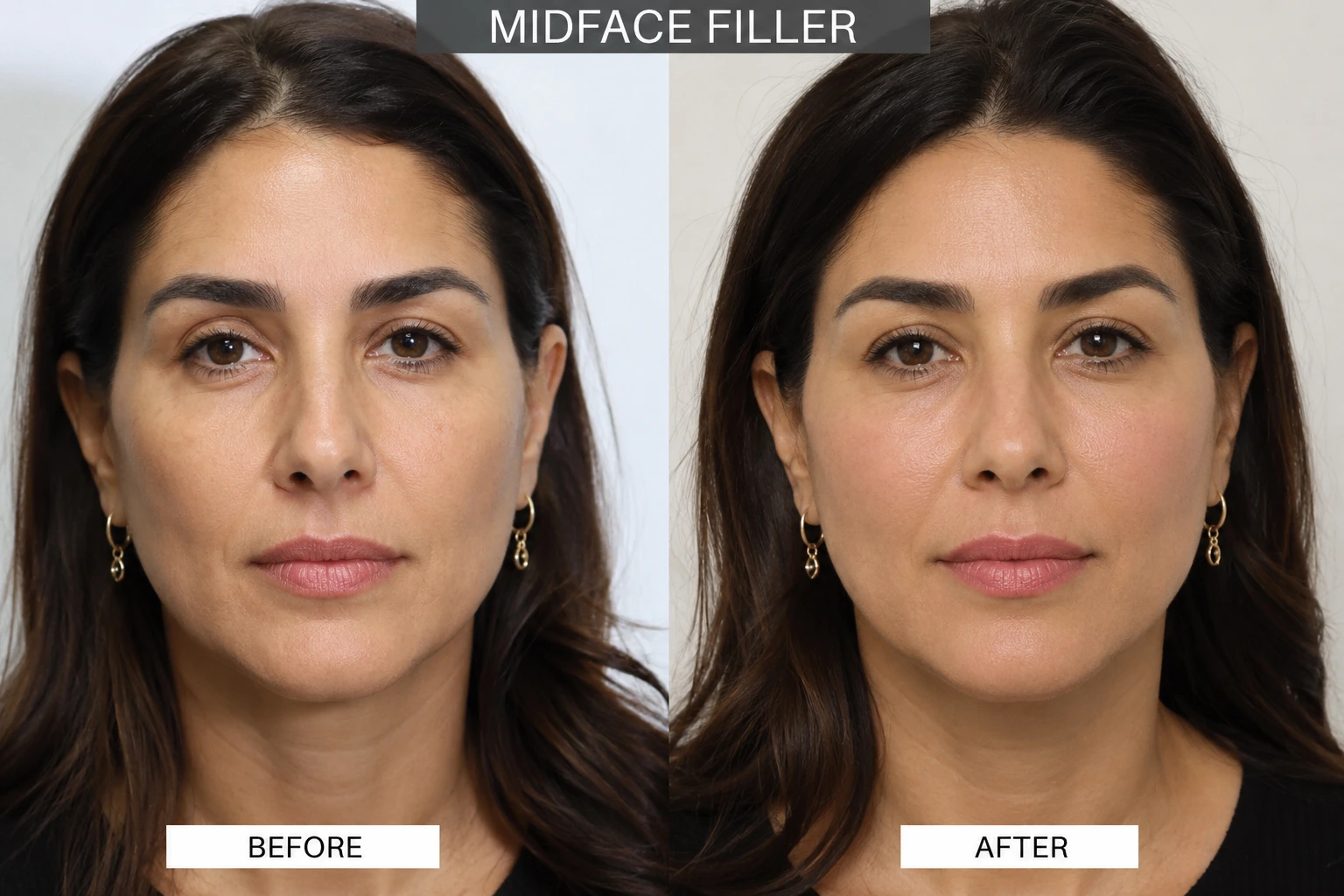
The middle third of the face carries much of what people read as youth. Full cheeks, a smooth transition from the lower eyelid down onto the cheek, and a jawline that looks supported all trace back to volume sitting high on the face. When that volume slips, the face begins to look tired before it ever looks lined.
A growing number of clients ask whether they can address that change without a surgical lift. They can. Placed with intention, dermal fillers in Rockaway Park, Queens can rebuild the structure of the midface and create a visible lift in the tissue below it. The result reads as a rested version of your own face rather than a different one.
This guide explains why the midface ages the way it does, how filler produces lift instead of simple plumping, which products do the work, and what a treatment plan built around your anatomy actually looks like.
Why the midface ages the way it does
The midface sits between the lower eyelid and the corner of the mouth, layered over the cheekbone and the upper jaw. Its shape depends on fat that is held in defined pockets rather than spread as one even sheet. Anatomists describe these pockets as separate fat compartments, each bounded by thin partitions of connective tissue, which is why the face does not deflate evenly as it ages.
One compartment matters more than the rest. The deep fat that pads the inner cheek against the bone behaves like a cornerstone for the whole midface. When it thins, everything above it loses its footing, which is why injectors treat that deep pad as a priority target when the goal is a lifting effect rather than a surface fill.
Several changes then stack on top of one another. The deep fat that rests against the cheekbone shrinks, so the scaffold beneath the skin loses height. The bone of the eye socket and the upper jaw recedes slightly, which pulls support out from underneath. The retaining ligaments that anchor the cheek loosen, and the fat that remains drifts lower on the face. A curve that was once full and high over the cheekbone flattens at the top and pools further down, near the nasolabial fold and along the jaw.
This is the reason a midface in its forties can look heavier and more drawn at the same time. Volume has not simply vanished. It has migrated to a place where it works against you, leaving hollows beneath the eyes, a deflated upper cheek, and deeper folds bracketing the mouth.
None of this responds to a topical cream, because the change happens well below the skin rather than at its surface. It involves the deep fat and the bone it rests on, neither of which a serum can reach. A treatment plan that lasts has to address the structure underneath instead of chasing the lines on top.
How filler creates a lift and a fill
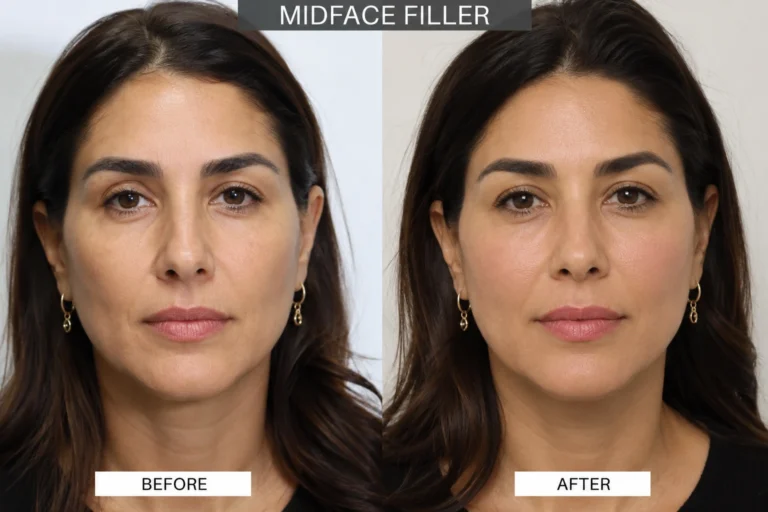
The obvious move is to fill the lines and hollows head on. A more durable result comes from rebuilding the support that those lines and hollows sit on. When a small amount of firm filler is placed deep against the cheekbone, in the same plane where the deep cheek fat used to live, it restores height to the scaffold. The skin and fat resting on that scaffold rise with it. Folds soften from below instead of being packed from the front, and the lower face looks gently raised.
This approach is often called a liquid lift or a nonsurgical midface lift. The lift is modest next to surgery, and it is real. By supporting the cheek high and toward the side, an injector can take tension off the nasolabial fold and soften the shadowed hollow where the lower eyelid meets the cheek. The face you see is lifted along the same vectors a surgeon would respect, achieved with a syringe in place of a scalpel.
In practice, a client who walks in with a flat, shadowed upper cheek often leaves with that area restored to a soft curve, while the crease running from the nose to the mouth looks shallower than it did an hour earlier. The change shows in the mirror straight away, and it keeps settling over a week or two as any swelling fades.
The table below sets the two routes side by side so the trade-offs are easy to weigh.
| Consideration | Surgical midface lift | Filler midface lift |
| Approach | Repositions deeper tissue and trims laxity through incisions near the hairline or eyelid | Rebuilds lost volume on the cheekbone so the tissue above it lifts |
| Anesthesia | General or deep sedation | Topical numbing, sometimes none |
| Downtime | Two to several weeks of swelling and bruising | Most people return to daily life the same day |
| When results show | Once swelling settles over the following weeks | Immediately, then refining over one to two weeks |
| How long it lasts | Many years | Roughly twelve to twenty-four months, depending on the product |
| Reversibility | Permanent | Hyaluronic acid filler can be dissolved if needed |
| Best suited to | Advanced sagging with excess skin | Early to moderate volume loss |
The fillers that do the work
The midface rewards products firm enough to hold structure against the pull of gravity. Two families handle most of the work here.
Hyaluronic acid fillers are gels based on a sugar your body already produces. The thicker formulations in this group, built for cheek projection, give immediate lift and can be dissolved if a correction is ever wanted. They are the workhorse of midface volumizing, and their popularity reflects that role.
According to the American Society of Plastic Surgeons, hyaluronic acid fillers rank as the second most requested minimally invasive cosmetic procedure in the United States, with more than 5 million performed in a single recent year, trailing only neuromodulators such as Botox.
Biostimulatory fillers work on a slower clock. Materials such as calcium hydroxylapatite and poly-L-lactic acid prompt your own skin to lay down fresh collagen, so the improvement builds over months and tends to hold. They suit clients who prefer gradual, structural change over an instant result.
Many plans combine the two, using a firm hyaluronic acid gel for immediate scaffolding and a biostimulator to thicken the surrounding tissue over time. This kind of layered, full-face thinking sits at the center of our signature Natural Needle Lift™, which draws on a custom mix of neuromodulators, fillers and other needle-based treatments. If you are newer to injectables and want a feel for how a conservative, natural result is built, our guide to lip filler for beginners walks through the same philosophy applied to the lips.
What strategic placement looks like in practice
Every plan starts with an assessment in front of a mirror. The injector studies how your cheek sits at rest and how it moves when you smile, then maps the points where support has been lost. Photographs from the front and the side help track the plan as it progresses.
The injection itself favors precision over volume. Firm filler goes deep, onto the bone, where it can act as a structural pillar. Softer filler may be feathered higher to smooth the surface. Many injectors reach for a blunt cannula rather than a sharp needle across parts of the midface, since a cannula glides through tissue with less trauma and slips past the vessels that thread through this region. The midface holds important arteries, which is one of the strongest arguments for choosing an experienced clinical injector over a discount provider.
Two signs suggest the midface is the right place to begin:
- The upper cheek looks flatter than it did a decade ago, while the area near the mouth or jaw looks heavier and fuller.
- Concealer keeps settling into the groove under your eyes no matter how well you slept.
After the appointment the treated area may feel firm and look a little swollen, much like the day after a long flight. That eases within a few days. Most people are comfortable heading back to work right away, with a couple of things to skip for the first day, including strenuous exercise and firm pressure on the cheeks from sleeping face down.
Filler also has limits worth naming. When skin has lost real elasticity and hangs in loose folds, adding volume beneath it can make heaviness worse rather than better. A careful assessment flags that early and points toward skin tightening or a surgical opinion instead of more product.
| Planning tip: Book your first midface session at least two weeks ahead of any event you care about. Filler can bring mild swelling or the occasional small bruise, and giving the result time to settle means you walk in looking your best rather than freshly treated. |
How long the lift lasts
Longevity depends on the product, the amount placed, and how quickly your body metabolizes it. A firm hyaluronic acid filler in the cheek commonly holds for twelve to twenty-four months. Biostimulators can run longer as the collagen they build matures. Most clients return for a small top up roughly once a year, which keeps the scaffold supported and lets the injector adjust the plan as the face continues to change.
Spreading treatment across more than one visit is both common and sensible. Building volume gradually guards against overcorrection and keeps the outcome believable, which matters more on the midface than almost anywhere else on the face.
Pairing filler with skin tightening and threads
Filler rebuilds volume, and on its own it does little for loose skin or rough surface texture. When laxity is part of the picture, a combined plan tends to read better than filler alone. A PDO thread lift in Queens, NY places dissolvable sutures under the skin to reposition tissue and spur collagen, which complements the structural base that filler provides. For clients whose main concern is crepey or sagging skin, Ultherapy skin tightening in Queens, NY uses focused ultrasound to firm the deeper layers with no injection at all.
An injector who treats the face as a whole will tell you plainly when filler is the answer and when another tool will serve you better. You can read more about that mindset in our piece on why injectables do more than fight wrinkles.
Why the injector matters more than the syringe
The same syringe of filler can produce a refreshed, lifted midface in one set of hands and a heavy, overfilled look in another. Placement, depth and product choice are judgment calls earned through training and through treating a great many faces. A skilled injector reads the early warning signs of a vessel problem and stays in the safe planes that keep the midface out of trouble.
Nicole Frontera Beauty is led by a family nurse practitioner, and every plan begins with an individual assessment rather than a fixed template. You can read about our team and clinical approach on our about page.
Book your midface consultation in Rockaway Park
A lifted, well-supported midface is within reach for most people long before surgery becomes the right call. The work rests on careful placement, the right product for your anatomy, and an injector who understands how the middle of the face holds the rest of it up.
To find out whether a midface filler plan suits you, book a complimentary consultation at our Rockaway Park location in Queens. A clinician will assess your facial structure, talk through your goals, and design a plan around the face you already have.
References
- Rohrich RJ, Pessa JE. The fat compartments of the face: anatomy and clinical implications for cosmetic surgery. Plastic and Reconstructive Surgery. 2007;119(7):2219-2227.
- Surek CC, Beut J, Stephens R, Jelks G, Lamb J. Pertinent anatomy and analysis for midface volumizing procedures. Plastic and Reconstructive Surgery. 2015;135(5):818e-829e.
- American Society of Plastic Surgeons. Plastic Surgery Statistics Report. plasticsurgery.org.
