
Botox was once associated almost exclusively with patients in their late forties and fifties, but now has become a widely discussed option for patients in their twenties and thirties. According to the American Society of Plastic Surgeons, neuromodulator injections among patients aged 20 to 39 grew by more than 8% in a single year, reflecting a measurable shift toward earlier, more intentional treatment.
Yet the question remains deeply individual. There is no universal birthday that signals readiness. The right time depends on your skin, your anatomy, your goals, and the quality of guidance you receive.
The Real Answer Has Nothing to Do with a Number
Most dermatologists and experienced injectors agree on this point: the ideal time to start Botox is not determined by your birth certificate. It is determined by what your facial muscles are doing.
When you raise your eyebrows, frown, or squint, the underlying muscles contract and create temporary creases in the skin above them. In younger skin, those creases disappear the moment your face relaxes. Over time, as collagen production slows and the skin loses elasticity, those temporary lines become etched into the tissue. They remain visible even when the face is completely at rest.
That transition is the clinical signal. Once lines begin lingering at rest, the muscles responsible have been folding the skin in the same pattern for long enough that the crease has become structural. Neurotoxin treatment at this stage is corrective. Neurotoxin treatment before this stage is preventative.
Both approaches are valid, and both produce excellent results. The distinction matters because it shapes the treatment plan, the dosage, the frequency, and the expectations you should carry into your first appointment.
| WHAT YOUR INJECTOR IS ACTUALLY ASSESSING
During a consultation for Botox in Rye, NY, your provider evaluates several things beyond age: the strength and recruitment pattern of your facial muscles, the depth and location of any existing lines, your skin thickness and elasticity, and how your face moves during natural expression. Two patients of the same age can have entirely different treatment recommendations based on these factors. |
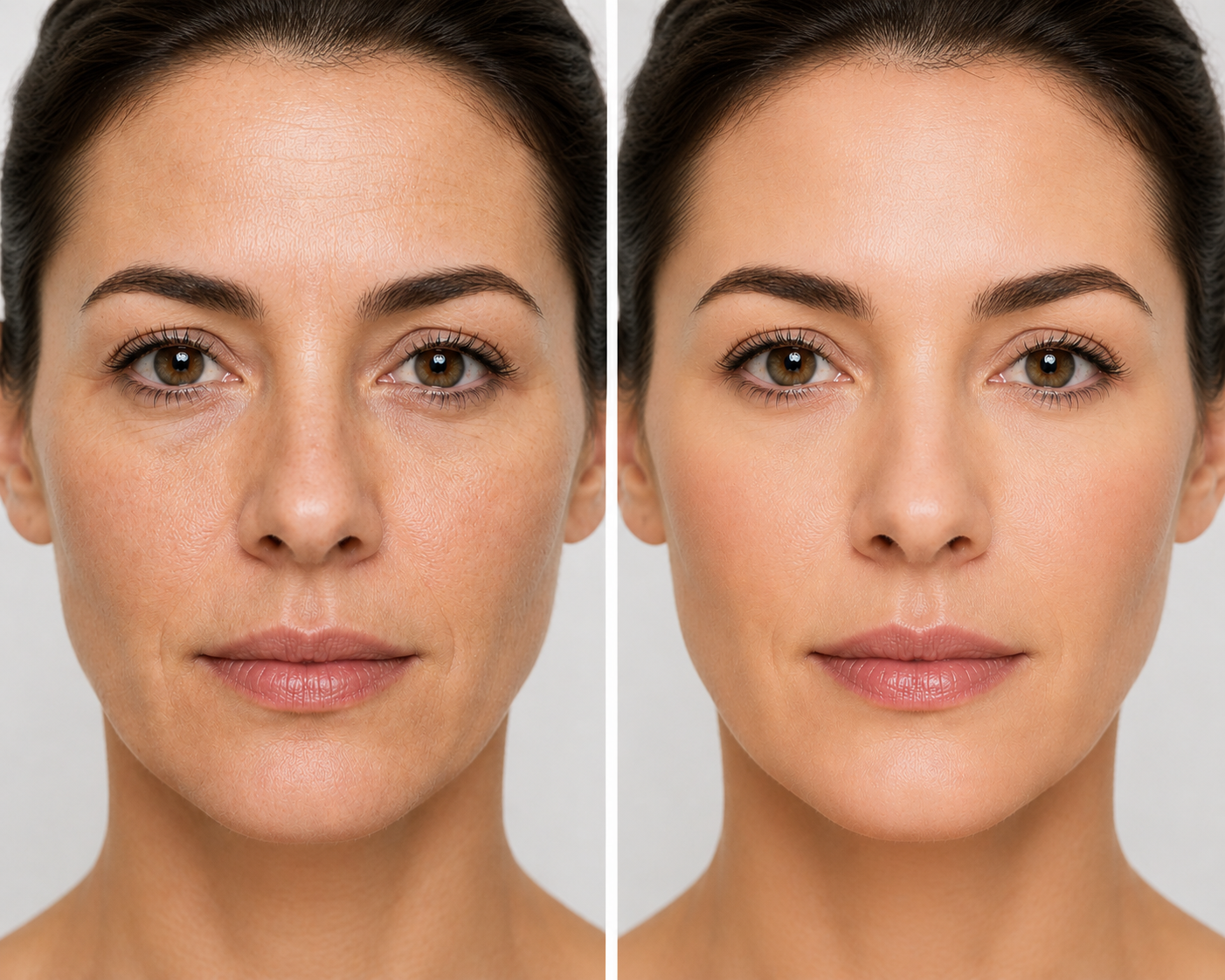
What Happens to Your Skin in Each Decade
| AGE RANGE | WHAT IS HAPPENING | TREATMENT RELEVANCE |
| Early 20s | Collagen production is still robust. Skin recovers quickly from expression. Fine lines typically appear only during active movement. | Rarely necessary. Skincare, sunscreen, and lifestyle habits offer the most impact at this stage. |
| Mid to Late 20s | Collagen production begins to slow by roughly 1% per year. Patients with strong facial expressiveness may notice faint lines forming between the brows or across the forehead. | Preventative neurotoxin can be appropriate for patients with visible early muscle patterns. Low doses produce excellent results. |
| Early to Mid 30s | Lines at rest become more common. Crow’s feet, forehead lines, and the glabellar complex (between the brows) become more defined. Skin elasticity continues to decline. | This is the most common age range for starting treatment. Both preventative and early corrective approaches are effective. |
| 40s and Beyond | Volume loss, skin thinning, and deeper static wrinkles become more prominent. Expression lines are well established. | Neurotoxin remains highly effective and is often combined with complementary treatments for a comprehensive result. |
Your provider will assess where you fall on this spectrum based on your individual anatomy, not a generalized chart.
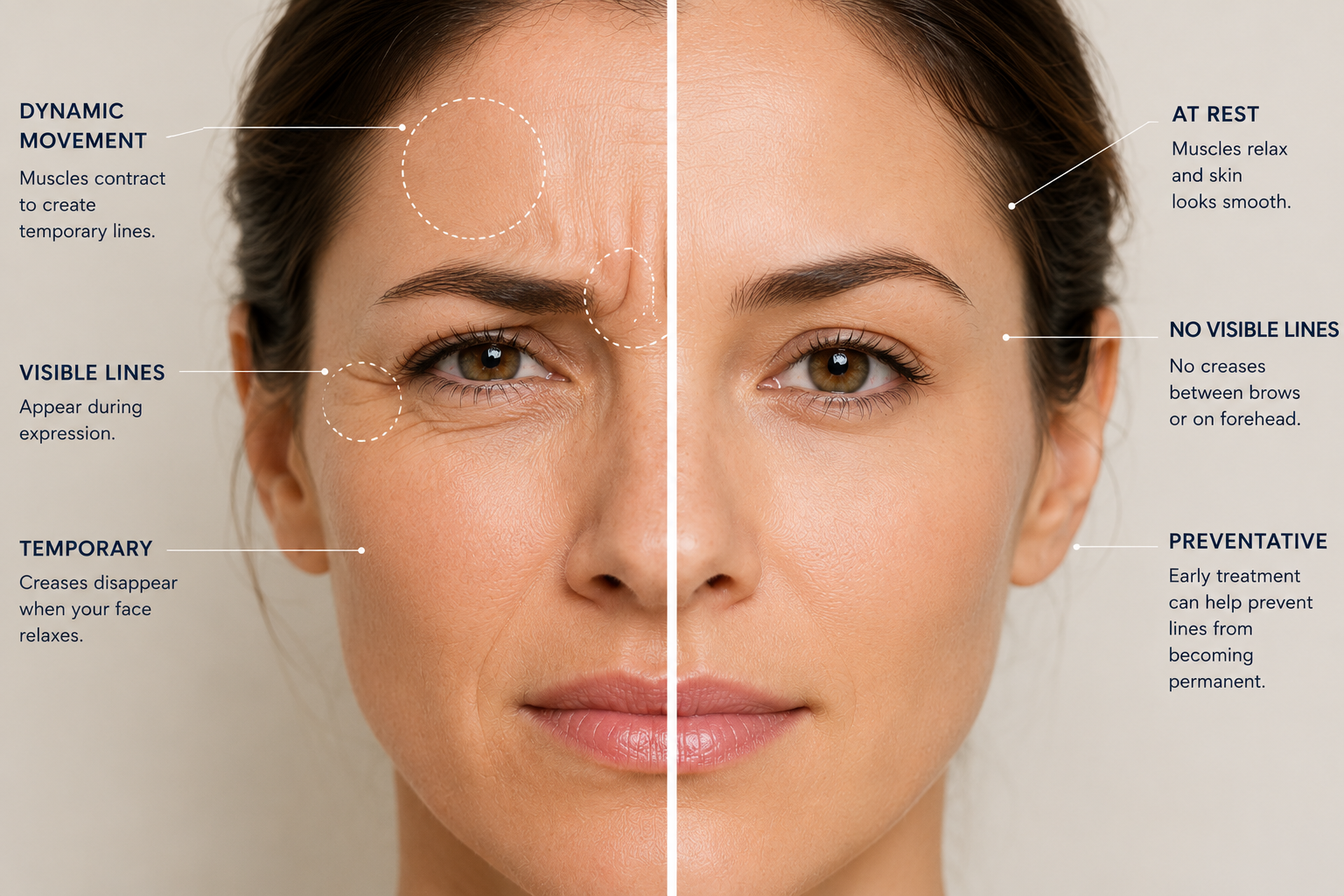
What Preventative Botox Actually Means
Preventative neurotoxin treatment is the strategic use of small doses of botulinum toxin to relax facial muscles before the lines they create become permanent.
If a muscle is prevented from contracting with its full force over a sustained period, the skin above it is never folded deeply enough, or frequently enough, to form a lasting crease. The wrinkle never forms because the mechanical cause of the wrinkle has been softened.
The doses used in preventative treatment are intentionally conservative. The goal is to preserve natural movement and expression while reducing the intensity of the contractions that cause long-term creasing. When performed by a skilled injector, the result is imperceptible to others. You simply look like yourself, with skin that ages more slowly and more gracefully.
Patients who begin preventative treatment often find two significant benefits over time:
- They require lower doses at each subsequent visit, because the treated muscles gradually lose their tendency to over-contract
- Their results tend to last longer between sessions, as the muscles become trained to move with less force
This cumulative benefit is one of the reasons experienced providers often encourage patients to consider neurotoxin before deep lines have formed, rather than waiting until correction requires more product and more frequent visits.
Signs Your Skin May Be Ready
If you are wondering whether it is time to explore neurotoxin treatment, pay attention to what your skin does when your face is at rest. Stand in front of a mirror with neutral lighting and relax your expression completely.
Then ask yourself the following questions:
- Do faint lines remain between your brows even when you are not frowning?
- Are there horizontal creases across your forehead that persist after you stop raising your eyebrows?
- Do the corners of your eyes show fine lines when you are not smiling?
If the answer to any of these is yes, your muscles have been folding the skin in those areas long enough to leave a visible trace.
This is the earliest and most reliable sign that treatment could be beneficial.
If your skin still returns to a completely smooth surface when your face is relaxed, neurotoxin may not yet be necessary. In that case, the most impactful investment is a high-quality skincare routine, consistent sun protection, and a relationship with a provider who can monitor your skin over time and advise you when the window for preventative treatment opens.
The Case Against Starting Too Early
While the trend toward younger treatment is well documented, responsible providers caution against beginning neurotoxin injections purely out of anxiety or social media influence. Treating muscles that do not yet need intervention offers no clinical benefit and can create an unnecessary financial commitment.
A 22-year-old with minimal facial movement and no visible lines at rest does not need Botox. What that patient needs is education, a strong skincare foundation, and the confidence to know that starting later is not starting too late.
The best injectors are the ones who will tell you when you do not need treatment. That honesty is a hallmark of ethical practice, and it is something we take seriously at The Formula.
| A NOTE ON STARTING LATER IN LIFE
If you are in your forties, fifties, or beyond and have never had neurotoxin treatment, it is absolutely not too late. Botox remains remarkably effective for softening established lines and preventing them from deepening further. Many patients in this age range also benefit from combining neurotoxin with treatments like dermal fillers in Rye, NY to restore volume, or Ultherapy in Rye, NY for deeper structural tightening. The approach simply shifts from prevention to correction and maintenance, and the results can be just as elegant. |
What to Expect at Your First Appointment
For patients who have decided the timing is right, the first neurotoxin appointment is simpler than most people expect. The treatment itself takes approximately 10 to 15 minutes. A very fine needle delivers small amounts of botulinum toxin into targeted muscles. Most patients describe the sensation as a brief pinch.
There is no downtime. You can return to your daily routine immediately, with only minor precautions such as avoiding intense exercise and keeping the treated area upright for a few hours.
Results begin to appear within three to five days and reach their full effect by two weeks. The initial treatment serves as a baseline for your provider to evaluate how your muscles respond, how your skin softens, and what adjustments may benefit you at your next session.
Most patients return every three to four months initially. Over time, as the muscles adapt, many find they can extend the interval between treatments while maintaining a consistently smooth, natural result.
Neurotoxin as Part of a Broader Aesthetic Plan
One of the most important things to understand about Botox is that it addresses one specific dimension of aging: the dynamic wrinkles caused by muscle movement. It does not replace volume, tighten lax skin, or improve surface texture. Those concerns require different tools.
A patient in her mid-thirties might benefit from neurotoxin for expression lines, a customized facial in Rye, NY for skin health, and a plan for future RF microneedling in Rye, NY to support collagen density as she ages.
That kind of long-term thinking is what separates a reactive approach from a strategic one.
Why the Injector Matters More Than the Timing
No amount of research can substitute for the judgment of an experienced, anatomy-driven injector. The difference between a beautiful result and an unnatural one often comes down to the provider’s understanding of facial proportions, muscle recruitment, and the art of restraint.
A skilled injector knows how to preserve your natural expressions while softening only the movements that contribute to aging. They understand that the forehead, brow, and eye area are interconnected, and that over-treating one zone can shift the balance of the entire face. They also know when to recommend waiting.
At The Formula Medspa, our approach to Botox and neurotoxin treatments in Rye, NY is guided by anatomy, proportion, and a deep respect for each patient’s natural features.
Frequently Asked Questions
What is the youngest age you can get Botox?
Botox is FDA-approved for cosmetic use in patients 18 and older. However, most experienced providers recommend waiting until there is a clinical indication, such as early lines at rest, before beginning treatment. For most patients, this occurs somewhere between the mid-twenties and early thirties.
Is 25 too young for Botox?
Not necessarily. If you have visible lines forming at rest, particularly in the forehead or between the brows, 25 can be an appropriate age to begin preventative treatment. Your provider will evaluate your specific anatomy and muscle patterns to determine whether treatment is warranted.
Will I look frozen if I start Botox early?
When administered conservatively and by an experienced injector, Botox produces a soft, natural result. The goal of early treatment is not to eliminate movement but to reduce the intensity of the contractions that cause lasting lines. Most patients report that others cannot tell they have had anything done.
How often do I need Botox once I start?
Most patients schedule treatments every three to four months initially. Over time, as the targeted muscles weaken, many patients find they can extend the interval to four or even five months while maintaining their results.
Can I combine Botox with other treatments?
Absolutely. Neurotoxin pairs well with a range of treatments depending on your goals. Many patients combine it with chemical peels in Rye, NY for texture, dermal fillers for volume restoration, or laser treatments in Rye, NY for tone and clarity. Your provider will design a plan that addresses your priorities in a cohesive, strategic way.
What happens if I stop getting Botox?
Your muscles will gradually return to their full range of movement, and lines will resume forming at their natural pace. You will not look worse than you did before treatment. In many cases, patients who used Botox preventatively for several years find that their skin still appears smoother than it would have without any treatment at all.
The Right Time Is the Time That Is Right for You
There is no single correct age to start Botox. There is only the moment when your skin, your goals, and your readiness align. Whether that moment arrives at 27 or 47, the most important step is choosing a provider who will guide you with honesty, expertise, and a commitment to results that look like you, only refreshed.
At The Formula Medspa in Rye, NY, every treatment begins with a complimentary consultation designed to understand your skin, your concerns, and your long-term vision.
